
An audit-ready food business maintains updated FSSAI documentation, conducts regular product testing through NABL-accredited laboratories, trains its team on Schedule 4 compliance requirements, and treats audits as a routine operational process rather than a last-minute exercise.
| Metric | Data Point | Source |
|---|---|---|
| FSSAI penalty (per violation) | ₹1 lakh – ₹5 lakh | FSSAI Act, 2006 – Section 92 |
| Audit findings flagging documentation gaps | ~68% | Equinox Labs review of 400+ audits (2023–2025) |
| Average product recall cost | ₹12–₹40 lakh | Industry benchmarks |
| Brands passing audit on first attempt (NABL-tested) | 81% | Equinox Labs review of 200+ client outcomes |
Applicability
Who Needs to Be Audit-Ready?
FSSAI audits can apply to food businesses of all sizes — manufacturing, processing, packaging, serving, or exporting food products.
This checklist is designed for:
Food Manufacturers
D2C Food Brands
Cloud Kitchens
Packaged Food Companies
Food Exporters
Restaurant Chains
Food Processing Units
Important: Whether you operate a single facility or multiple locations, maintaining organised audit records, testing reports, SOPs, and compliance documentation is essential for long-term FSSAI compliance and successful audits.
Quick Reference
FSSAI Audit Checklist
Before an FSSAI inspection, ensure you can answer "Yes" to all of the following:
| Requirement | Status |
|---|---|
| Valid FSSAI licence with current locations and categories | ✓ / ✗ |
| Product testing conducted as per risk category | ✓ / ✗ |
| Schedule 4 records maintained | ✓ / ✗ |
| Recent NABL-accredited laboratory reports available | ✓ / ✗ |
| Labels compliant with FSSAI regulations | ✓ / ✗ |
| Supplier quality documents available | ✓ / ✗ |
| Process water testing records available | ✓ / ✗ |
| Compliance owner assigned | ✓ / ✗ |
Brands that can confidently answer "Yes" across these areas are typically better prepared for inspections, customer audits, retailer evaluations, and export assessments.
Definition
What Does FSSAI Audit-Ready Mean?
Being audit-ready means your documentation, product testing records, labelling, and SOPs are always current so that an FSSAI inspection never catches you off guard.
Many food businesses prepare for audits only when they receive a notice. The most successful brands build compliance into their everyday operations. As a result, inspections become routine events instead of business disruptions.
Core Requirements
4 Requirements to Pass an FSSAI Audit
Most successful food businesses consistently focus on four compliance areas.
01
Documentation Is Always Current
Your FSSAI licence, Schedule 4 records, supplier certificates, incoming material records, and batch-wise testing reports should be organised, accessible, and updated. When an inspector requests documentation, the ability to provide records immediately creates confidence in your systems.
02
Product Testing Is Conducted Regularly
Businesses that perform routine testing through NABL-accredited food testing laboratories maintain a continuous compliance trail. During inspections, historical test records often become as important as the current production batch.
03
Labels Are Verified Before Launch
The FSS Act and Labelling & Display Regulations require mandatory declarations including:
Product Name
Net Quantity
Best-Before Date
Ingredient Declaration
Nutritional Information
Allergen Declaration
FSSAI Licence Number
A single labelling error can trigger audit observations, product withdrawal, or retailer rejection. Before approving packaging artwork, review an FSSAI labelling compliance guide to verify all mandatory declarations are included and correctly displayed.
04
Employees Understand Compliance Responsibilities
Food safety compliance should not depend on a single founder or quality manager. Production teams, supervisors, and quality personnel should understand inspection requirements and know where records are maintained.
India Scenario
Why Audit Readiness Matters
Many food businesses face compliance challenges not because their products are unsafe, but because documentation, testing records, and regulatory updates are not maintained consistently.
Problem
A Mumbai cloud kitchen expanding from three to twelve locations received an unannounced FSSAI inspection at its commissary facility. While the business held a valid central licence, amendments for newly added locations had not been updated. Testing records were scattered across multiple folders.
Impact
Operations were temporarily disrupted, a monetary penalty was imposed, and retail supply discussions were delayed while documentation was corrected.
Action Taken
The company implemented a structured testing calendar, centralised documentation management, and digital batch traceability across all facilities.
What We Learn
Compliance challenges rarely arise because food is unsafe. They occur because records are incomplete, inaccessible, or outdated.
What To Do
Maintain a single physical and digital compliance folder containing licences, Schedule 4 records, test reports, SOPs, and supplier documents.
Review licences, amendments, and labels every quarter.
Establish a routine testing schedule aligned with product risk.
Prepare an Inspector Kit containing your licence, recent test reports, and compliance records.
Train at least two employees on inspection requirements and document management.
Testing Schedule
How Often Does FSSAI Require Food Testing?
Testing frequency depends on product risk, manufacturing process, distribution model, and regulatory requirements.
Many brands test products during launch and then stop. Months later, when an audit or retailer assessment occurs, there are no recent records available. This documentation gap frequently becomes a compliance concern.
Recommended Testing Frequency
High-Risk Categories — Monthly
- Dairy products
- Ready-to-eat foods
- Packaged drinking water
- Infant food
- Meat and poultry products
Medium-Risk Categories — Quarterly
- Packaged snacks
- Bakery products
- Condiments
- Edible oils
- Processed grains
Export Products
Testing requirements may apply per shipment based on importing-country regulations and buyer specifications.
What To Do
Classify products into risk categories.
Create an annual testing calendar.
Test both finished products and critical raw materials.
Ensure reports include batch numbers and manufacturing dates.
Align testing parameters with retailer, exporter, or customer requirements.
FSSAI Compliance Testing
What Food Testing Parameters Does FSSAI Require?
FSSAI requires evaluation for microbiological safety, contaminants, heavy metals, pesticide residues, and nutritional parameters depending on product category.
One of the most common audit findings is not a failed result — it is the absence of appropriate testing.
| Food Category | Microbiological Parameters | Chemical / Contaminant Parameters |
|---|---|---|
| Packaged Drinking Water | Total Coliform, E. coli | Heavy Metals, Nitrates, Fluoride |
| Dairy Products | TPC, Coliform, Salmonella, Listeria | Aflatoxin M1, Antibiotics |
| Ready-to-Eat Foods | TPC, Yeast & Mould, E. coli | Pesticides, Trans Fats |
| Edible Oils | Quality Indicators | Heavy Metals, Adulterants |
| Packaged Spices | Salmonella, Yeast & Mould | Pesticides, Aflatoxins |
| Meat Products | Salmonella, Listeria | Preservatives, Heavy Metals |
India Scenario — Problem
A packaged spice manufacturer tested only microbiological parameters prior to product launch. During market surveillance, elevated pesticide residue levels were identified.
Impact
The company incurred recall costs, re-testing expenses, and retailer confidence challenges.
Action
The business expanded its testing programme to include pesticide residue analysis and heavy metal screening for all spice-based products.
What We Learn
Testing only part of the required parameters can create the same business risk as not testing at all.
What To Do
Go beyond basic microbiological testing.
Include pesticide residue testing for spices, grains, and oils.
Include heavy metal analysis where applicable.
Review testing requirements before introducing new products.
Use NABL-accredited laboratories for compliance and customer acceptance.
Scaling Compliance
How Can Food Businesses Stay FSSAI-Compliant While Scaling?
As businesses grow, compliance complexity increases. More products, more suppliers, more facilities, and more distribution channels create additional compliance responsibilities. The most effective solution is building a simple operational system.
Compliance Framework
One Compliance Calendar
Schedule recurring activities:
- Product testing
- Documentation review
- Label verification
- Licence review
One Laboratory Partner
Working with a consistent laboratory improves process efficiency, reporting consistency, and testing continuity.
One Internal Compliance Owner
Assign responsibility to a trained employee rather than relying solely on founders or business owners.
Label Verification Before Launch
Every new SKU should undergo a structured compliance review before printing and production.
Annual FSSAI Compliance Calendar
| Quarter | Activity |
|---|---|
| Q1 | Product Testing Review |
| Q2 | Documentation Audit |
| Q3 | Label Compliance Review |
| Q4 | Licence & Supplier Review |
Following a quarterly schedule significantly reduces compliance surprises and inspection-related stress.
Need Help Preparing For An FSSAI Audit?
Equinox Labs helps food businesses with food testing, NABL-accredited reports, label verification, shelf-life studies, and compliance support.
Talk To Our Experts Audit Readiness
FSSAI Audit Readiness Checklist
| # | Requirement | Status |
|---|---|---|
| 1 | FSSAI licence valid and updated | ✓ / ✗ |
| 2 | Product testing conducted as scheduled | ✓ / ✗ |
| 3 | Schedule 4 records maintained | ✓ / ✗ |
| 4 | Labels reviewed for compliance | ✓ / ✗ |
| 5 | Supplier certificates available | ✓ / ✗ |
| 6 | Water testing records maintained | ✓ / ✗ |
| 7 | Compliance owner assigned | ✓ / ✗ |
| 8 | Inspector Kit prepared | ✓ / ✗ |
Businesses that consistently maintain these eight elements are generally better positioned for FSSAI inspections, retailer audits, and export evaluations.
Need a practical starting point?
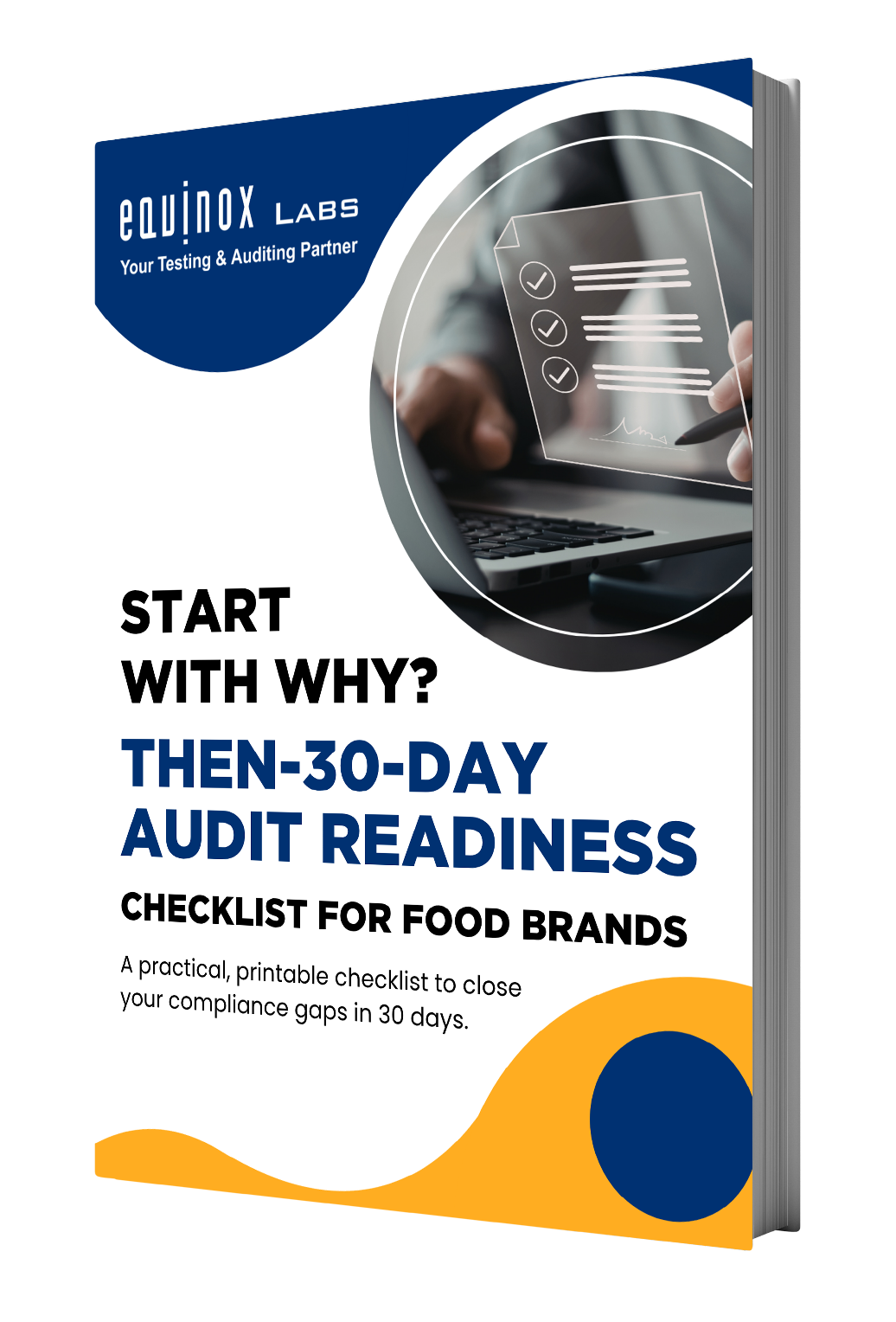
Download our 30-Day FSSAI Audit Readiness Checklist for Food Brands to review licences, testing records, traceability, staff training, and compliance documentation before your next inspection.
Expert Perspective
"
Most food businesses do not struggle because their products are unsafe. They struggle because they cannot demonstrate compliance through documentation, testing records, and traceability systems. Audits reveal the strength of operational systems. Businesses that review compliance every quarter rarely face surprises during inspections.
FAQ
Frequently Asked Questions
For most categories, quarterly testing is considered the minimum best practice. High-risk products such as dairy, ready-to-eat foods, and packaged drinking water typically require more frequent testing.
Depending on the nature of the violation, consequences may include penalties, corrective actions, product recalls, licence suspension, or legal proceedings under applicable provisions of the Food Safety and Standards Act.
Businesses should use NABL-accredited laboratories. NABL accreditation demonstrates compliance with ISO 17025 quality standards and is widely accepted by regulators, retailers, and export buyers.
Commonly requested documents include: FSSAI licence, Schedule 4 records, product test reports, supplier certificates, batch records, and employee training records.
Yes. D2C brands, cloud kitchens, home-based food businesses, manufacturers, and retailers are all subject to applicable FSSAI registration or licensing requirements.
Labels should include all mandatory declarations specified under the FSS (Labelling and Display) Regulations, including ingredients, nutritional information, allergen declarations, net quantity, dates, and licence number.