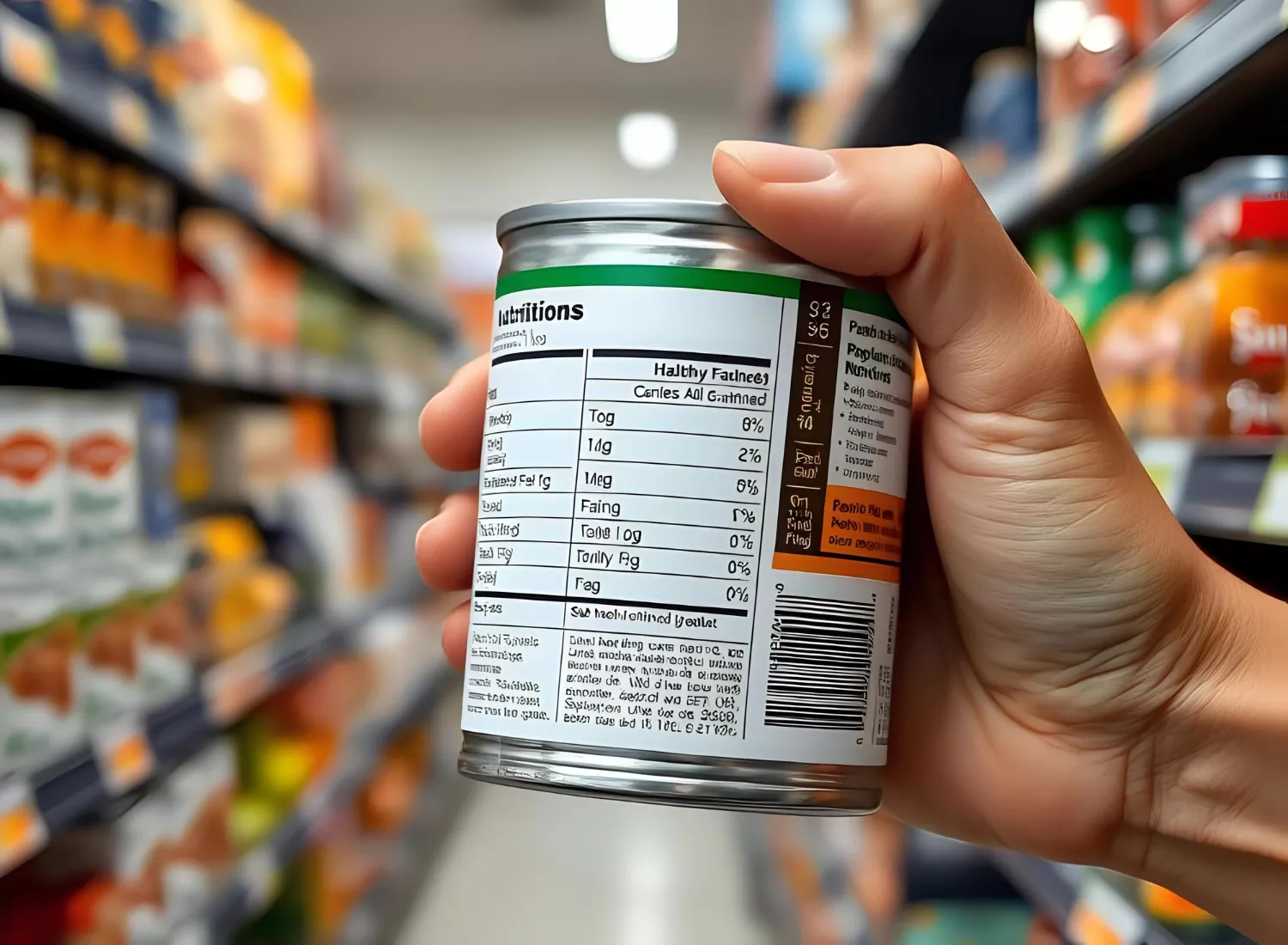
Most consumers spend under 10 seconds deciding what to pick off a shelf. They do not flip the pack. They do not read the nutrition table on the back. They look at the front and move on.
Front-of-package nutrition labeling, also called front-of-pack nutrition labeling or FOPL, is simplified nutritional information placed on the principal display panel of a packaged food. It communicates the nutritional quality of food products at a glance, without requiring consumers to decode a full nutrition label.
For Indian F&B businesses, this is now a live Supreme Court matter. On February 10, 2026, the Supreme Court asked FSSAI to seriously evaluate the introduction of front-of-pack warning labels on packaged foods, citing concerns over excessive sugar, saturated fat, and sodium. FSSAI has been directed to respond within four weeks making this the most urgent front-of-package labelling development India has seen.
What is Front-of-Package Nutrition Labeling?
A front-of-package label gives consumers basic nutrition information in a format that is easy to understand and allows product comparison in seconds. These labels typically highlight nutrients linked to adverse health outcomes: sodium, added sugar, and saturated fat.
There are two main types of front-of-pack food labeling. Summary indicators provide an overall health score based on an algorithm, such as a star rating or traffic-light system. Nutrient-specific indicators display individual nutrient amounts on the front panel. Research consistently shows that summary systems are easier for consumers to understand, while nutrient-specific systems are better suited to engaged, health-literate shoppers.
Only some adults correctly interpret the percentage Daily Value on back-of-pack nutrition labels. For the majority of Indian consumers across income and education levels, the front-of-package label is the only nutrition information they actually use at the point of purchase.
India's Front-of-Package Labelling Regulations: Where Things Stand in 2026
September 2022 — FSSAI Proposes the Indian Nutrition Rating (INR)
FSSAI issued a draft notification proposing the Indian Nutrition Rating (INR), a star-rating model from 0.5 stars (least healthy) to 5 stars (most beneficial). The INR evaluated both negative nutrients (sugar, saturated fat, and sodium) and positive nutrients (fiber and protein). The star rating would appear on the front of package label near the product name. Source
April 2025: Supreme Court Issues First Binding Directive
The Supreme Court in April 2025 directed the Central Government to finalise front-of-pack nutrition labelling norms within three months, arising from a PIL filed under Article 32 of the Constitution. The Court emphasised the right to health under Article 21 and the need to empower consumers with visible, accurate nutritional information. source
October 2025 — FSSAI Moves to Withdraw INR Draft
After receiving over 14,000 stakeholder representations, FSSAI's Committee of Scientists concluded the INR front of package labelling regulations were unfit for finalisation in their current form and recommended withdrawal for comprehensive reconsideration. The second expert review pointed to the lack of consensus and the need for a contextually acceptable system of front-of-pack nutrition labelling source
February 10, 2026: The Most Recent Supreme Court Directive
The Supreme Court urged FSSAI to consider mandating front-of-pack warning labels for high sugar, sodium, and saturated fat alongside a positive logo for healthier products. The Court observed that the exercise undertaken so far had not yielded concrete results, cautioned that it may intervene directly if FSSAI fails to act, and directed a response within four weeks.
The Effect of Front-of-Package Nutrition Labeling: What the Evidence Shows
A meta-analysis of 114 studies found that front-of-package nutrition labeling consistently helps consumers identify healthier products. Interpretive FOPL systems that provide an overall healthfulness judgment had a greater positive effect on food choices than nutrient-specific systems that only list numbers.
The strongest real-world proof comes from Chile, which introduced mandatory black stop-sign warning labels in 2016. Nutrition labeling on food purchases showed a measurable impact: purchases of high-in beverages declined significantly, outperforming Chile's prior standalone sugar-sweetened beverage tax. This is direct, population-level evidence that front-of-package label design changes what people actually buy.
Beyond consumer choice, the effect of front of package nutrition labeling extends to product reformulation. When front-of-pack food labelling schemes penalise high-sugar or high-sodium scores, manufacturers reformulate to achieve better ratings improving the nutritional quality of food products across entire categories, not just individual items.
India's NCD context makes this evidence directly applicable. NCDs now account for 61% of all deaths in India, up from 37% in 1990. Unhealthy diets high in salt, fat, and added sugar are among the primary contributing factors. This is precisely why the Supreme Court has intervened repeatedly: the cost of delayed front-of-pack nutrition labelling implementation is measurable. source
What F&B Businesses Must Do Right Now
The INR model has stalled, but existing front of package labelling regulations remain fully enforceable today. An independent study found that nearly one-third of labelling claims reviewed across Indian packaged foods were non-compliant — with the highest rates in honey, ghee, edible oils, tea, plant-based beverages, and ready-to-eat meals. Here is what to action immediately:
- Audit your current front-of-pack layout: Under FSS Labelling and Display Regulations 2020, total sugar, salt, and saturated fat must already be displayed in bold and larger font with % RDA on the front of pack. This is enforceable today not pending the Supreme Court's final order.
- Verify all nutritional values through laboratory testing. FSSAI has flagged misleading nutrition label claims across multiple categories. Declared values on your front-of-package label must be verified by a NABL-accredited laboratory before printing packaging, not estimated from databases.
- Review your product category risk. If your products include honey, ghee, edible oils, tea and herbal infusions, plant-based beverages, or ready-to-eat meals — you are in the highest non-compliance risk categories identified under current regulatory scrutiny.
- Monitor the FSSAI four-week response deadline. The Supreme Court's February 10, 2026 directive requires FSSAI to respond within four weeks. FSSAI has established July 1 as its annual enforcement date with a minimum 180-day transition window once front of package labelling regulations are finalised. Subscribe to FoSCoS notifications now.
- Begin reformulation assessment. Warning labels create a visible, shelf-level disadvantage for products high in sugar, salt, or fat. Brands that reduce these inputs before enforcement and can demonstrate verified nutritional improvements will be positioned to lead rather than react.
How Equinox Labs Can Help You
Meeting front-of-package labelling regulations is not just about design it starts with accurate, verified nutritional data. Equinox Labs is a NABL-accredited testing laboratory with over two decades of experience supporting F&B businesses across India in meeting FSSAI compliance requirements.
- Nutritional Testing for Front-of-Package Labels. We test your product for all parameters required on the front of package label energy, total fat, saturated fat, trans fat, total sugar, and sodium with results structured for direct use in FSSAI label declarations.
- Health Claim Substantiation. If your packaging carries nutrition or health claims, we provide the laboratory data to substantiate them, reducing your risk in the high-non-compliance categories FSSAI has flagged: honey, ghee, edible oils, plant-based beverages, and ready-to-eat meals.
- INR and Warning Label Readiness. When FSSAI finalises the front pack labelling model whether INR star ratings or warning labels your product's nutrient profile will need to be submission-ready. We help you understand your current score and identify reformulation opportunities before enforcement.
- Shelf-Life and Stability Testing. Accurate front-of-pack nutrition labelling requires that declared values hold throughout the product's shelf life. Our stability testing confirms that nutritional values at the point of purchase match what is declared on the front of the pack.
- Pan-India Testing with Fast Turnaround. With labs across India and NABL-accredited testing infrastructure, we support F&B businesses from product development through to full regulatory compliance with turnaround times built around packaging and launch timelines.
Whether you are reviewing your current front-of-pack nutrition labelling for the first time or preparing for the Supreme Court's expected post-April 2026 enforcement direction Equinox Labs gives you the verified nutritional data you need to act with confidence.
Conclusion: FOPL Is Now a Business Decision, Not Just a Compliance One
The front-of-pack food labelling debate in India is no longer about whether it will happen. The Supreme Court has issued multiple directives, the INR draft has been pulled back for redesign, and warning label language is being discussed at the bench level. Once implemented, front-of-package nutrition labeling will change what consumers buy, how products are compared on shelf, and what the nutritional quality of food products looks like across entire categories.
For Indian F&B businesses, the choice is straightforward: prepare now with verified nutritional data and compliant front-of-package labeling or react when enforcement tightens.
FAQs
Yes, partly. Right now, food companies must show sugar, salt, and fat content in bold on the front of the pack. But a full system like a star rating that tells you at a glance if a product is healthy or not is still being finalized by FSSAI.
The INR was a proposed system where packaged foods would get a star rating from ½ star (unhealthy) to 5 stars (healthy) similar to how hotels are rated. FSSAI proposed it in 2022, but it was put on hold in 2025 because too many businesses and experts disagreed on how it should work. A new version is expected soon.
Yes and there is real data to prove it. When Chile made warning labels mandatory on packaged foods in 2016, people bought significantly less sugary and salty products almost immediately. A review of 114 global studies confirmed the same simple, easy-to-read labels on the front of a pack genuinely influence what goes into people's shopping baskets.
Independent audits have found the highest non-compliance in honey, ghee, edible oils, tea, plant-based drinks, and ready-to-eat meals. If your business sells any of these, your current labels are more likely to be flagged by FSSAI inspectors.
Three simple steps: check that your current packaging already shows sugar, salt, and fat in bold with daily percentage values (this is required today, not in the future); get your nutritional values tested by a certified lab before your next print run; and keep an eye on FSSAI updates because once the Supreme Court order is finalized, businesses will have around 180 days to update all packaging.